
Seven Wonders of the Ancient World
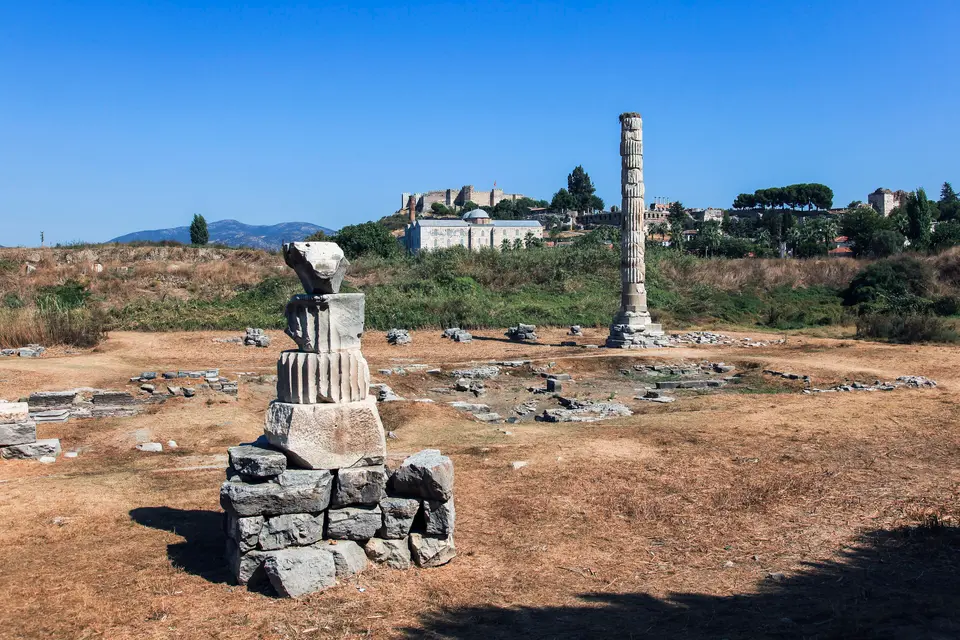
The Temple of Artemis at Ephesus was among the largest buildings of the Greek world, dedicated to a goddess who combined Greek Artemis with an older Anatolian fertility deity. A first great temple, financed by the Lydian king Croesus in the sixth century BCE, was designed by the architects Chersiphron and Metagenes and adorned with carved column drums. It was burned in 356 BCE by a man seeking fame, a night said to coincide with the birth of Alexander the Great, and was rebuilt on a still grander scale. The later temple, with a forest of Ionic columns, was famed for its sculpture and treasuries and drew pilgrims and traders. Its decline came with the rise of Christianity and invasions in the third century CE; the site gradually silted up, and its marble was reused for churches and other buildings. Excavations in the nineteenth century, led by John Turtle Wood for the British Museum, located the foundations. Today the sanctuary lies in a quiet marshy field at the foot of Ayasuluk Hill, marked by a single column assembled from original drums, stone fragments and foundations. Nearby stand the Basilica of St John and İsa Bey Mosque. The nearby ancient city of Ephesus, a separate UNESCO World Heritage property, preserves Roman streets, theatre and the Library of Celsus. Visiting the temple site is brief but evocative, best paired with Ephesus and the museum in Selçuk, where artefacts are displayed.
How to visit
Foundations and one re-erected column. Original temple mostly dismantled; significant fragments are in museums, including the British Museum.
- Gateway
- İzmir (ADB), about an hour by road or rail from Selçuk. The temple site is near Selçuk, a few kilometres from the Ephesus ancient city.
- Getting there
- Selçuk is reached by train or road from İzmir; the temple site is within walking distance of the town centre, while the ancient city of Ephesus is a short drive or walk.
- Access and booking
- The ancient city of Ephesus is ticketed by the Ministry of Culture and Tourism; separate access details for the Artemision are pending verification.
- Season and conditions
- Spring and autumn; summer is hot and crowded in Ephesus.
- Guides, permits and reservations
- None known for the temple site. Ephesus has its own tickets and museum pass options.
- Accessibility and physical demands
- The temple site is flat; details pending verification.
- What you can realistically visit today
- You can stand beside the lone column and foundations, then visit the Ephesus Archaeological Museum and Ephesus itself.
Checked against official sources
- The Ministry’s Ephesus pages list the site hours as opening at 08:00 and closing at 18:00 with ticket office closing at 17:30, and note that a combined ticket covers the ancient city and the Ephesus Experience Museum; prices differ across listings. — Türkiye Ministry of Culture and Tourism (muze.gov.tr)
Reviewed 2026-10-23. Official details change; confirm on the official page before you travel.
Pending verification
SATRAM has not verified the following; please check an official source:
- Whether the Artemision site has its own admission or hours.
- Current ticket prices and Museum Pass inclusions.
- Transport times from İzmir airport.
Official and useful links
Sources
Description and visit notes were written by SATRAM from these references. “Opened” means a page was read during the review; “cited” means it is listed as a standard reference and its address has not been machine-checked. Last reviewed .
- Ephesus — UNESCO World Heritage List — UNESCO World Heritage Centre · cited
- Ephesus Archaeological Site — Ministry of Culture and Tourism — Türkiye Ministry of Culture and Tourism · opened
- Temple of Artemis — Encyclopaedia Britannica · cited