
Seven Wonders of the Ancient World
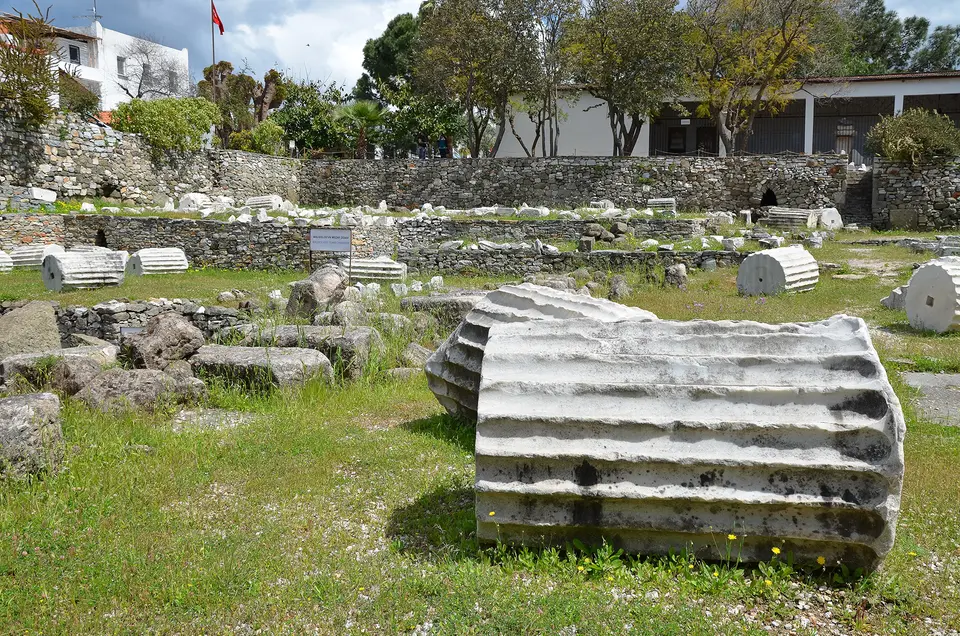
The Mausoleum at Halicarnassus was the tomb of Mausolus, a ruler of Caria under Persian authority, who died in 353 BCE. Begun in his lifetime and completed by his wife and sister Artemisia II, it combined Greek architecture with local ambition. Ancient descriptions tell of a tall marble structure of about forty-five metres, with a high podium, a colonnade of Ionic columns, a stepped pyramidal roof, and a chariot group at the summit. Leading Greek sculptors, among them Scopas, Bryaxis, Leochares and Timotheos, are said to have carved its friezes and statues. The tomb stood for roughly 1,800 years until earthquakes brought it down, and in the early fifteenth century the Knights of St John used its stones to build Bodrum Castle, burning some of the marble for lime. In the 1850s the archaeologist Charles Newton excavated the site and shipped sculptures, including colossal statues thought to represent Mausolus and Artemisia and fragments of the frieze, to the British Museum, where they are displayed. What remains in Bodrum is the quarried foundation area and a small museum with models and finds, a modest place that invites imagination. Visitors can combine it with Bodrum Castle and its Museum of Underwater Archaeology, and see the surviving sculptures in London. The word mausoleum itself, now used for any grand tomb, is the lasting legacy.
How to visit
Foundations only on site; sculptures in London. The monument was dismantled and reused; major sculptures are in the British Museum.
- Gateway
- Bodrum (BJV, Milas–Bodrum Airport). The site is in central Bodrum, near the castle and harbour.
- Getting there
- Bodrum is reached by air from Istanbul and other cities, or by road from Muğla and İzmir; the site is a short taxi ride or walk from the harbour.
- Access and booking
- The Mausoleum memorial museum is ticketed by the Ministry of Culture and Tourism; the Museum Pass Aegean does not include it, so a separate ticket is needed.
- Season and conditions
- Spring and autumn; summer is hot and crowded.
- Guides, permits and reservations
- None known beyond the ticket.
- Accessibility and physical demands
- Pending verification.
- What you can realistically visit today
- You can see foundations, a model and excavation finds at the memorial museum, then visit Bodrum Castle and see sculptures in Room 21 of the British Museum in London.
Checked against official sources
- The Ministry’s museum listing gives the address as Turgutreis Caddesi No:93, Bodrum, with a separate ticket for foreign adults; the Aegean Museum Pass covers more than 40 sites but does not include this one. — Türkiye Ministry of Culture and Tourism listing
- The British Museum displays colossal statues and relief slabs from the Mausoleum in Room 21. — British Museum
Reviewed 2026-10-23. Official details change; confirm on the official page before you travel.
Pending verification
SATRAM has not verified the following; please check an official source:
- Opening hours of the Bodrum memorial museum.
- Current ticket price.
Official and useful links
Sources
Description and visit notes were written by SATRAM from these references. “Opened” means a page was read during the review; “cited” means it is listed as a standard reference and its address has not been machine-checked. Last reviewed .
- Mausoleum of Halikarnassos — British Museum — British Museum · cited
- Muğla Bodrum Mausoleum Memorial Museum — Türkiye Ministry of Culture and Tourism · opened
- Mausoleum at Halicarnassus — Encyclopaedia Britannica · cited