
New 7 Wonders of Nature
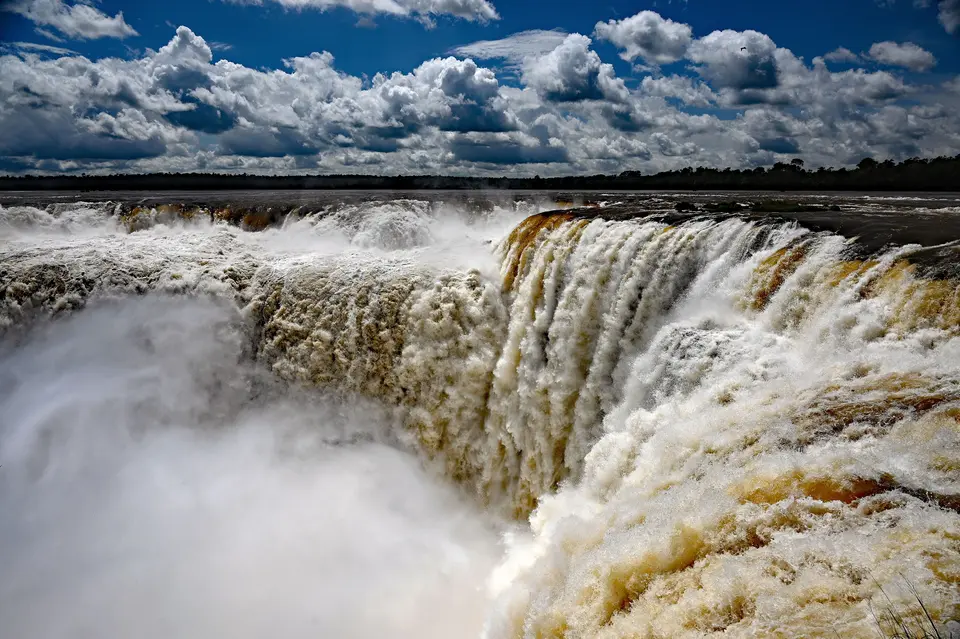
Iguazú Falls is not one waterfall but a sweeping series of cascades, around 275 drops by common counts, strung along a precipice nearly three kilometres wide where the Iguazú River plunges from the Paraná plateau. The name comes from the Guaraní words for big water. The most famous section is the Devil’s Throat, a U-shaped chasm into which a huge volume of water thunders and sends up clouds of spray, often with rainbows. Most of the individual falls lie on the Argentine side, where walkways bring you close to the edge and the base, while the Brazilian side offers the broad panorama. Both countries protect the surrounding Atlantic Forest in national parks, and both parks are UNESCO World Heritage Sites. The forest teems with life: butterflies, toucans, coatis and, with luck, caimans and giant otters. The flow changes with rainfall; after heavy rains the falls turn brown and enormous, while in drier times individual cascades are more visible, and walkways can occasionally close because of high water. A typical visit spends one day on each side, reaching Argentina’s upper and lower circuits and the Devil’s Throat walkway, and Brazil’s walkway and viewpoint. Boat rides to the base of the falls are exhilarating and wet. Bring waterproofs, insect repellent and patience for crowds, and consider early or late visits.
How to visit
Protected natural site. Two national parks, one in each country.
- Gateway
- Puerto Iguazú, Argentina (IGR) or Foz do Iguaçu, Brazil (IGU). The two parks are about an hour apart, with a border crossing; Paraguay’s Ciudad del Este lies nearby.
- Getting there
- Fly into Puerto Iguazú (Argentina) or Foz do Iguaçu (Brazil), both near their parks. Taxis, buses and tour transfers connect each city to its park; crossing between countries needs passports and sometimes visas.
- Access and booking
- Argentine entry is managed by the park concessionaire, and Brazilian tickets are sold by the park operator with a visit date and time; fees differ by nationality.
- Season and conditions
- Water volume varies with the season; year-round visits are possible. Summers are hot and humid, and winters mild.
- Guides, permits and reservations
- Bring ID or passport for border crossings. Check visa rules for both countries.
- Accessibility and physical demands
- The Argentine Devil’s Throat walkway is described as an accessible, stair-free route of about 1,100 m; other circuits have stairs. Verify current provision.
- What you can realistically visit today
- You can walk the Argentine circuits and Devil’s Throat walkway, ride the Ecological Jungle Train, take boat trips, and enjoy the panoramic Brazilian walkway.
Checked against official sources
- Argentina’s tourism board describes the Devil’s Throat as reached by an ecological train and accessible walkways, with a 1,100 m walkway without stairs; the park is in Misiones, 17 km from Puerto Iguazú. — Visit Argentina (Argentina.travel)
- The Brazilian side’s tickets are sold on the operator’s website with a scheduled visit date and time; the foreigner fare differs from the Brazilian/Mercosur fare. — Cataratas do Iguaçu (Urbia)
Reviewed 2026-10-23. Official details change; confirm on the official page before you travel.
Pending verification
SATRAM has not verified the following; please check an official source:
- Opening hours, current ticket prices and any visa requirements.
- Status of walkways after high-water events.
Official and useful links
Sources
Description and visit notes were written by SATRAM from these references. “Opened” means a page was read during the review; “cited” means it is listed as a standard reference and its address has not been machine-checked. Last reviewed .
- New7Wonders of Nature — official wonders page — New7Wonders Foundation · opened
- Iguazu National Park — UNESCO World Heritage List — UNESCO World Heritage Centre · cited
- Iguaçu National Park — UNESCO World Heritage List — UNESCO World Heritage Centre · cited
- Iguazú Falls — Visit Argentina — Argentina Tourism Board · opened