
Seven Wonders of the Ancient World
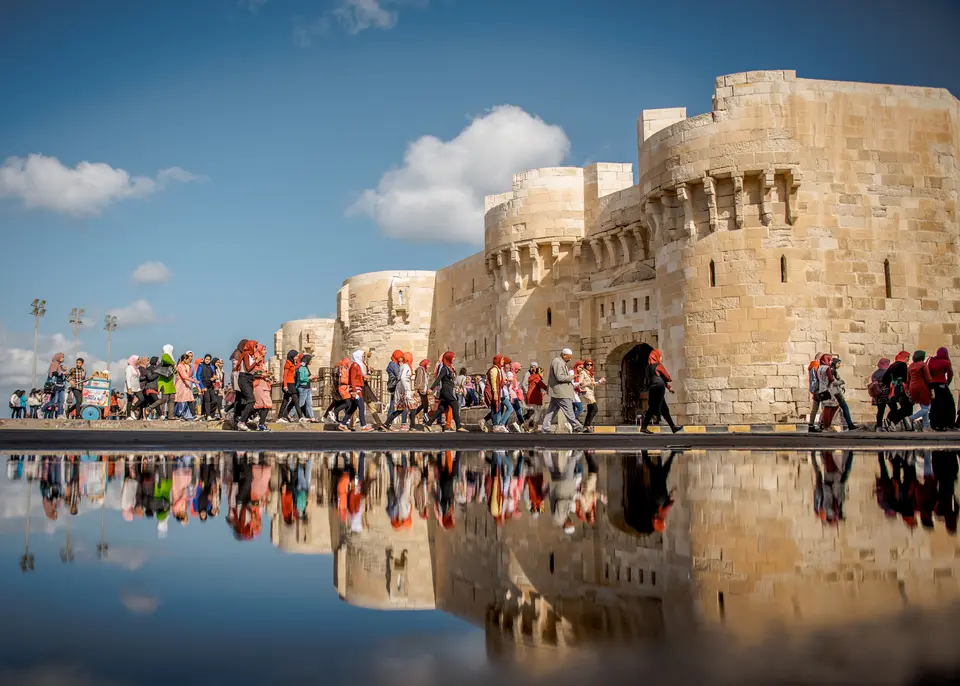
The Lighthouse of Alexandria, known as the Pharos, rose on a small island at the entrance of Alexandria’s harbour in the early third century BCE, under the first Ptolemies. Ancient writers describe a tall, multi-tiered tower of limestone and marble, with a square base, an octagonal middle and a cylindrical top bearing a fire and, perhaps, a polished reflector, visible far out to sea. Estimates of its height range around a hundred metres or more, making it among the tallest structures of the ancient world. It guided ships for about a thousand years, so influential that the word for lighthouse in several languages derives from Pharos. Earthquakes in the tenth, fourteenth and later centuries damaged it, and the last stones collapsed or were removed by the late fifteenth century, when Sultan Qaitbay built a fortress on the site, reusing fallen blocks. In the 1990s underwater archaeologists mapped hundreds of granite blocks, statues and columns in the harbour near the fort, some of which may have come from the lighthouse and other Ptolemaic buildings. Today the Qaitbay Citadel is a major landmark and museum, with views along the Corniche, while sunken remains are the preserve of divers and researchers with permission. The tower itself no longer exists. Visit for the fort, the harbour and the sense of ancient and medieval layers meeting at the sea’s edge.
How to visit
Destroyed; fortress built on the site; remains underwater. Blocks from the lighthouse were reused in Qaitbay Citadel and lie in the harbour.
- Gateway
- Alexandria (HBE) or Cairo (CAI), then train or road to Alexandria. Alexandria is a Mediterranean port city roughly two to three hours from Cairo by train or road.
- Getting there
- Trains and road transport link Cairo and Alexandria; local taxis and ride-hailing reach the citadel on the Corniche at the western end of the Eastern Harbour.
- Access and booking
- Qaitbay Citadel is ticketed by the Ministry of Tourism and Antiquities. Visiting the submerged site is only possible with authorised dive operators and permissions.
- Season and conditions
- Spring and autumn; summer is humid, winter can be windy.
- Guides, permits and reservations
- Underwater access needs a certified dive operator and official permission.
- Accessibility and physical demands
- The fort has steps and uneven surfaces; details pending verification.
- What you can realistically visit today
- You can tour Qaitbay Citadel, walk the seafront and see where the lighthouse stood. Underwater remains are accessible only on authorised dives.
Checked against official sources
- The Ministry of Tourism and Antiquities lists Qaitbay Fort as built in 1477–1479 over the ruins of the Lighthouse, with a sunken-monuments page describing a submerged site beginning at the edge of the citadel, extending about 150 m at 6–8 m depth. — Egypt Ministry of Tourism and Antiquities
Reviewed 2026-10-23. Official details change; confirm on the official page before you travel.
Pending verification
SATRAM has not verified the following; please check an official source:
- Opening hours (official page and ticket PDF differed) and ticket prices.
- Whether and how non-divers can view the submerged blocks.
Official and useful links
Sources
Description and visit notes were written by SATRAM from these references. “Opened” means a page was read during the review; “cited” means it is listed as a standard reference and its address has not been machine-checked. Last reviewed .
- Qaitbay Fort — Ministry of Tourism and Antiquities — Egypt Ministry of Tourism and Antiquities · opened
- Qaitbay Fort site (sunken monuments) — Egypt Ministry of Tourism and Antiquities · opened
- Lighthouse of Alexandria — Encyclopaedia Britannica · cited