
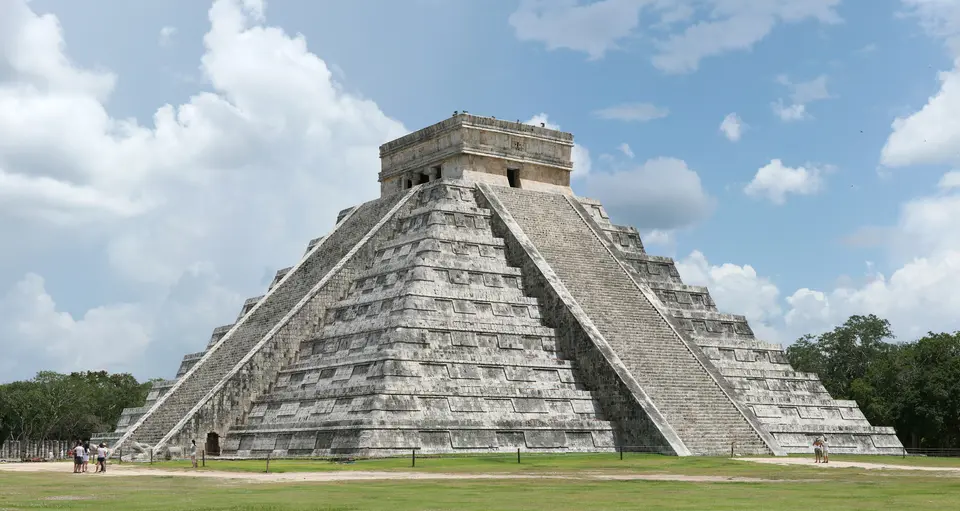
New Seven Wonders of the World
Chichén Itzá rose to prominence between about the ninth and eleventh centuries, when Maya and central Mexican traditions mingled in the northern Yucatán. Its landmark is El Castillo, the Temple of Kukulcán, a stepped pyramid with a stairway on each side. Combined, the stairs have 365 steps if the top platform is counted, and during the spring and autumn equinoxes the late-afternoon light creates the illusion of a serpent descending the balustrade. Nearby, the Great Ball Court, among the largest in Mesoamerica, has remarkable acoustics and carved panels that probably refer to the ritual game. The Temple of the Warriors and the Group of the Thousand Columns suggest assemblies and processions, while the round Caracol building is often described as an observatory. Water shaped the city’s identity: the Sacred Cenote, a natural limestone sinkhole, received offerings of jade, gold and other objects, and archaeological dives have recovered human remains. UNESCO has recognised the site, but Chichén Itzá remains a place where interpretations are debated, and signage and guides offer different perspectives. Climbing the monuments has been prohibited since the early 2000s to protect them. Most visitors come on day trips from Mérida or the Riviera Maya, so the plaza fills by midday. Visiting early and wandering beyond El Castillo, through the older buildings and shady paths, gives a quieter sense of scale.
How to visit
Excavated and restored. Many structures restored; climbing is not allowed.
- Gateway
- Mérida (MID) or Cancún (CUN). Roughly 115 km from Mérida; around two and a half to three hours by road from Cancún.
- Getting there
- By car or tour from Mérida (Highway 180) or Cancún; public buses reach Pisté, from where the entrance is a short distance. Check transport options for your travel day.
- Access and booking
- Tickets are bought at the site; entry includes a federal INAH fee and an additional Yucatán state fee. Free-entry rules for Mexican residents on Sundays exist for the federal fee.
- Season and conditions
- The cooler dry months are more comfortable; summer is hot and humid. Equinox dates draw crowds for the serpent shadow.
- Guides, permits and reservations
- No permit for ordinary visits. Climbing and entering structures is not permitted; drones are prohibited.
- Accessibility and physical demands
- Main paths are flat but unpaved and sun-exposed; detailed accessibility provision is pending verification.
- What you can realistically visit today
- You can walk the main plaza, the ball court, the Warriors group, the Caracol and the viewing point at the Sacred Cenote; some areas such as the older group may open or close.
Checked against official sources
- An INAH listing gives site hours as Monday to Sunday 08:00–17:00 with last access at 16:00, and notes the state government applies an additional fee; another INAH page gave shorter hours, so the figures conflict. — INAH / Yucatán government listings
- INAH states the site is about 115 km from Mérida on Highway 180, near the town of Pisté. — INAH
Reviewed 2026-10-23. Official details change; confirm on the official page before you travel.
Pending verification
SATRAM has not verified the following; please check an official source:
- Exact current hours and fees (sources conflict).
- Accessibility and any timed entry on equinox days.
Official and useful links
Sources
Description and visit notes were written by SATRAM from these references. “Opened” means a page was read during the review; “cited” means it is listed as a standard reference and its address has not been machine-checked. Last reviewed .
- New7Wonders of the World — official wonders page — New7Wonders Foundation · opened
- Pre-Hispanic City of Chichen-Itza — UNESCO World Heritage List — UNESCO World Heritage Centre · cited
- Zona Arqueológica de Chichén Itzá — INAH (Instituto Nacional de Antropología e Historia) · opened