
Seven Wonders of the Industrial World
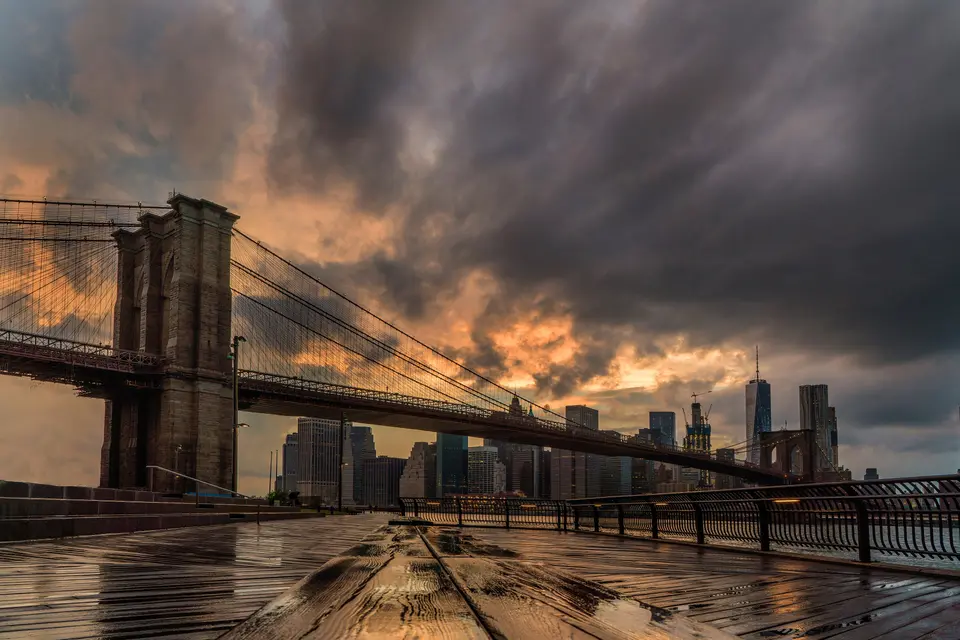
The Brooklyn Bridge opened on 24 May 1883 and linked the then separate cities of Manhattan and Brooklyn across the East River. It was designed by John A. Roebling, who died of tetanus after an accident during surveying in 1869. His son, Washington Roebling, took over as chief engineer, and when decompression illness left him bedridden, his wife Emily Warren Roebling became his vital link to the work, mastering the mathematics and managing relations with contractors and officials. The structure was an engineering milestone: its main span of nearly 486 metres made it the longest suspension bridge in the world at the time, and it was the first to use steel wire for its cables. Its stone towers, built with Gothic arches from granite and limestone, were raised from caissons sunk into the riverbed, where workers laboured in compressed air and many suffered from the then little understood bends. The web of diagonal stay cables gives the bridge its harp-like look. It carries vehicles on lower roadways and a pedestrian and bicycle promenade above, which has become one of the city’s best walks. Today the bridge is a National Historic Landmark, a symbol of New York and a working road crossing. Walking from Manhattan towards Brooklyn gives sweeping views of the skyline, the harbour and DUMBO’s cobbled streets. Expect crowds of walkers and cyclists, particularly at sunrise and sunset, and respect the separate lanes.
How to visit
In daily use. National Historic Landmark; periodically repaired.
- Gateway
- New York City (JFK / EWR / LGA). Subway stations at Brooklyn Bridge–City Hall (Manhattan) and High Street (Brooklyn) lead to the walkway.
- Getting there
- Subway to Brooklyn Bridge–City Hall (4, 5, 6) on the Manhattan side or High Street (A, C) on the Brooklyn side; many walkers start at City Hall Park.
- Access and booking
- The pedestrian promenade is free and open to the public; NYC DOT states it is open at all times, though portions may narrow during work.
- Season and conditions
- Year-round; early mornings and weekdays are quietest.
- Guides, permits and reservations
- The promenade is for pedestrians; bicycles use the separate protected bike lane on the Manhattan-bound roadway.
- Accessibility and physical demands
- The promenade is a ramp-like path rising gradually from each side; check DOT notices for work. Pending verification.
- What you can realistically visit today
- You can walk the promenade, photograph the skyline, and combine it with Brooklyn Bridge Park and DUMBO.
Checked against official sources
- NYC DOT’s Brooklyn Bridge page describes a pedestrian promenade separated from a protected two-way bicycle path, states the promenade will be open at all times, and notes occasional lane closures and narrowing for inspection and repair; 2026 projects are improving bicycle access at both ends. — NYC Department of Transportation
Reviewed 2026-10-23. Official details change; confirm on the official page before you travel.
Pending verification
SATRAM has not verified the following; please check an official source:
- Current construction impacts at the Manhattan and Brooklyn entrances.
Official and useful links
Sources
Description and visit notes were written by SATRAM from these references. “Opened” means a page was read during the review; “cited” means it is listed as a standard reference and its address has not been machine-checked. Last reviewed .
- Seven Wonders of the Industrial World (BBC series) — Wikipedia · opened
- Brooklyn Bridge — NYC DOT — NYC Department of Transportation · opened
- Brooklyn Bridge — Encyclopaedia Britannica · cited