
Overview
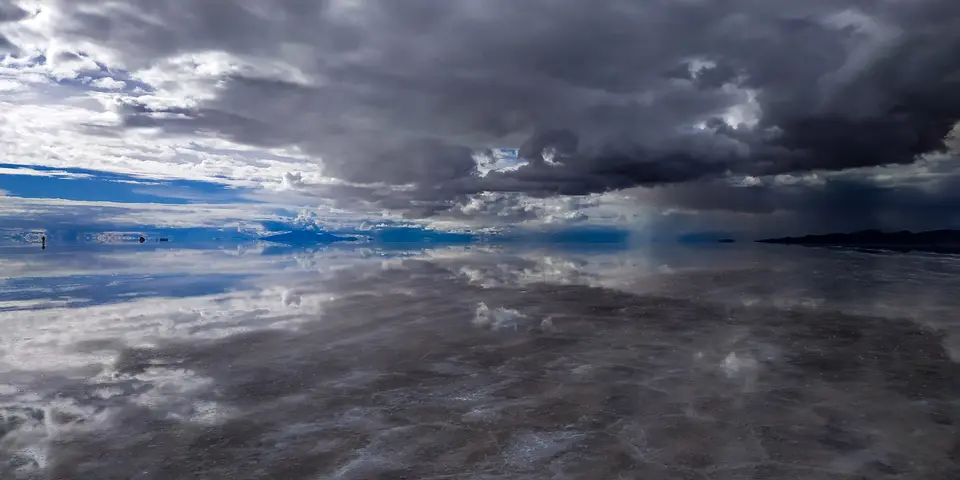
Here, the horizon loosens its hold. Clouds drift beneath your feet, and the sky stretches across a silent plain. Salar de Uyuni invites you into a landscape where distance feels endless.
Salar de Uyuni is the largest salt flat on Earth, about 10,582 square kilometres of white crust on Bolivia’s Altiplano at roughly 3,656 metres. It is what remains of prehistoric lakes that dried away, and it is so level that its height varies by less than a metre across the whole plain, flat enough for space agencies to calibrate satellites against it.
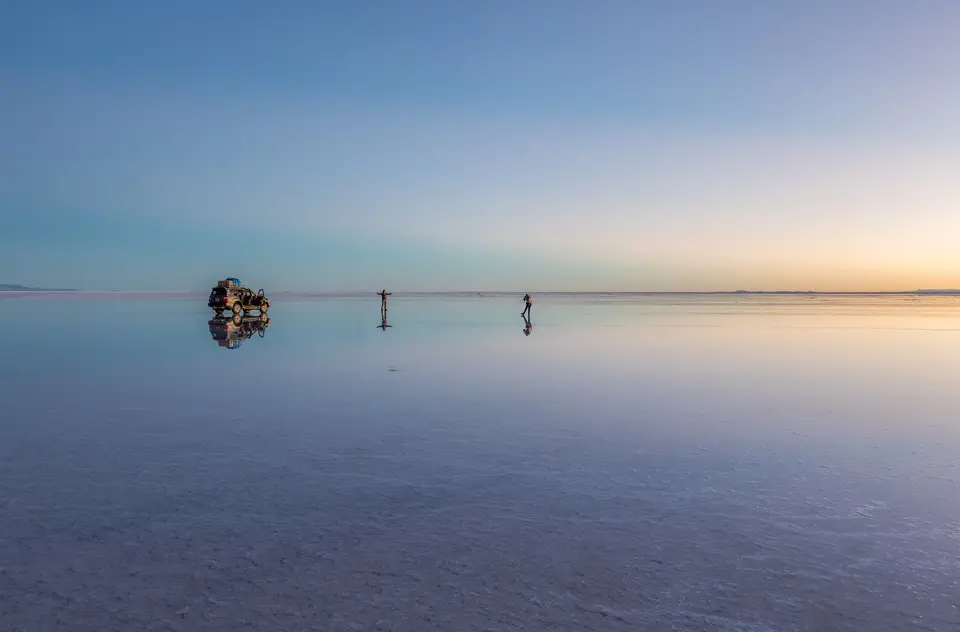
In the rainy season, roughly December to April, a thin film of water can settle on the crust. When the air is still, the salar becomes a mirror: clouds, mountains and travellers are doubled, and the line between earth and sky dissolves. The effect depends entirely on the weather. Too little rain leaves the crust dry; heavy rain can flood the tracks, and some routes, including Isla Incahuasi with its giant cacti, may be closed while the water is high.
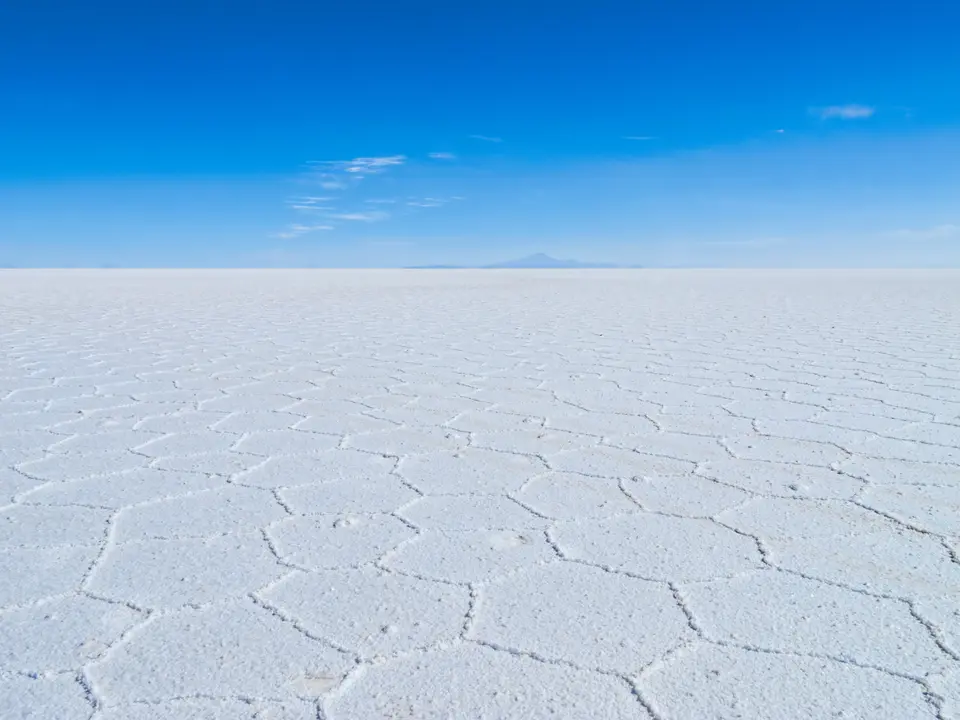
As the flat dries, the salt crystallises into ridged, hexagonal patterns that run to the horizon. The dry months bring clear skies, sharp light and the playful perspective photographs the salar is known for, along with nights well below freezing.
Sunrise and sunset are the quiet hours. Low light warms the crust, colour pools in the shallow water, and the silence can feel complete. Expect real cold before dawn and after dark.
The town of Uyuni, near the salar’s south-eastern edge, is the usual starting point. Most visitors join guided 4x4 excursions with licensed operators: day trips onto the flat, sunrise or sunset outings, and multi-day routes south across the Altiplano. The altitude is high and conditions change quickly, so allow time to acclimatise and confirm current access locally before you set out.
Best time to visit
The mirror is most likely in the rainy season, roughly December to April, but it depends on recent rain and still air and is never guaranteed; heavy rain can flood tracks and close routes such as Isla Incahuasi. May to November is dry, with clear skies, hexagonal salt patterns and wider access. June to August is the coldest period, with nights well below freezing.
Getting there and around
The town of Uyuni is the usual base. It is reached by domestic flights to Uyuni Airport (UYU), mainly from La Paz; by train on the Oruro–Uyuni line; or by long-distance bus. Services and schedules change, so check with the operators before you travel. On the salar itself most visitors go with guided 4x4 tours run by licensed operators from Uyuni; driving across the flat on your own is not advised, especially when it is wet.
Sample three-day itinerary
- Day 1 — Arrive in Uyuni. Arrive, rest and acclimatise to the altitude, then visit the train cemetery just outside town in the late afternoon.
- Day 2 — Across the salar. A full-day guided excursion onto the flat: the salt-working village of Colchani, Isla Incahuasi when it is accessible, and sunset on the salt.
- Day 3 — Sunrise on the flat. A pre-dawn outing for sunrise (dress for freezing cold), then rest in Uyuni or continue on a multi-day route south across the Altiplano.
A sample, not a booking. Opening hours, transport and seasonal closures change; confirm with official sources.
Indicative budget
Mid-range Mid-range. Guided excursions from Uyuni, domestic flights and warmer, well-insulated lodging are the main costs; compare licensed operators and exactly what each tour includes.
No live prices, weather, visa eligibility or availability are shown. Use the budget calculator for your own estimate.
Attractions
- The mirror. Shallow water after rain reflecting clouds and sky; it depends on the weather.
- Hexagonal salt crust. Ridged salt patterns that form as the surface dries.
- Isla Incahuasi. A rocky island of giant cacti in the middle of the salar; it may be closed when the flat is flooded.
- Train cemetery. Rusting locomotives about 3 km outside Uyuni, left from the mining-era railway.
- Tunupa. A dormant volcano at the northern edge of the salar, important in local Aymara tradition.
Packing guidance
- Good sunglasses: the white salt is intensely bright
- High-factor sun protection and a hat; the sun is strong at altitude
- Warm layers, a hat and gloves for freezing mornings and nights
- Footwear you can get wet in the rainy season
- Water, and any altitude advice or medication from your doctor
Gallery
Reviewed 2026-10-30. SATRAM’s notes are editorial guidance written from public references, not live travel information.